
一吻定情
China's Galbot robot takes on tennis star Zheng Jie in world's first human-robot match_我的网站

一 |
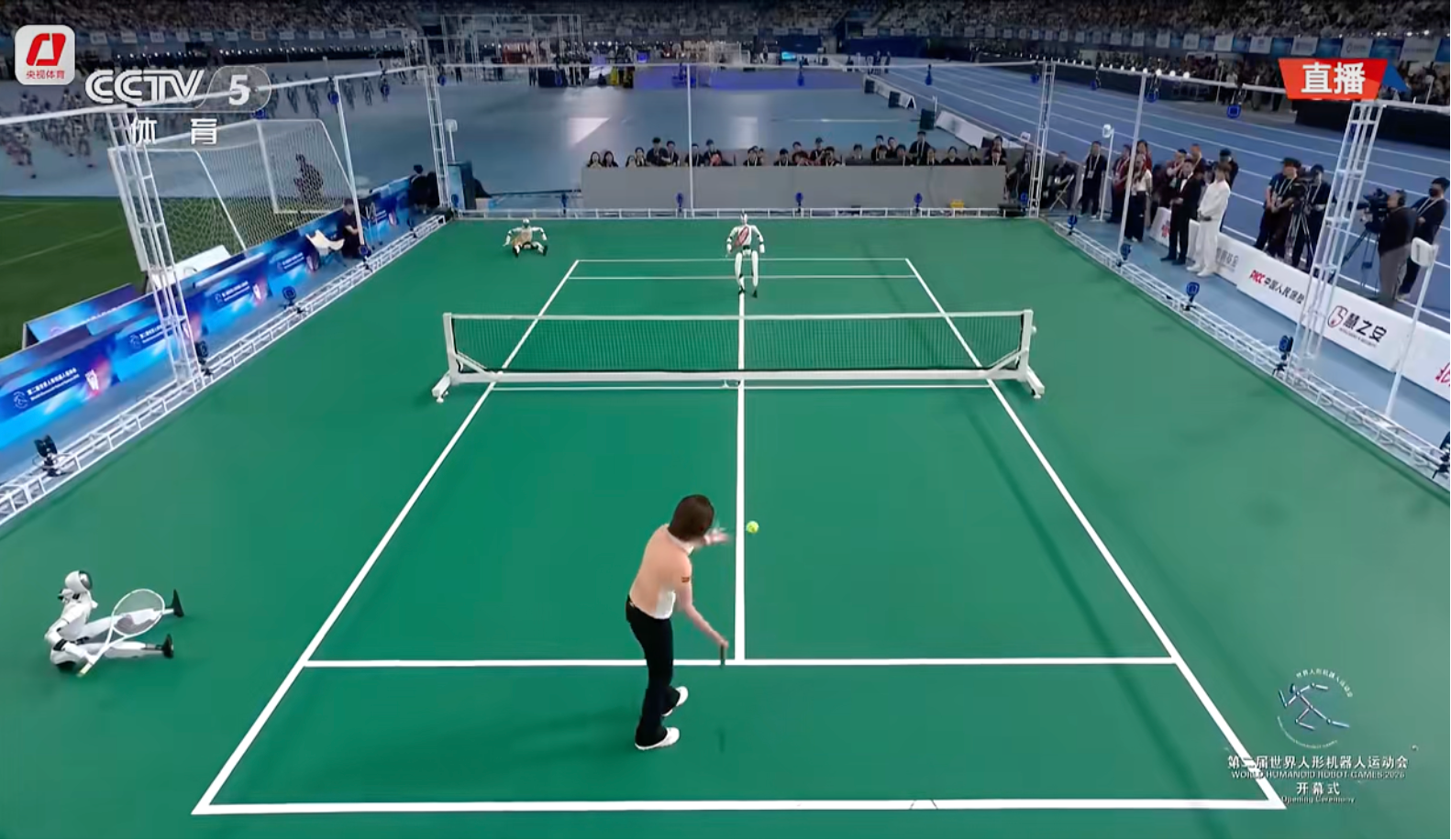
A humanoid robot went head-to-head with a former tennis champion in what was billed as the world's first human-robot tennis singles match, showcasing its ability to move, return shots and even recover from a fall during a high-intensity rally.
The match took place on Saturday as the second World Humanoid Robot Sports Games got underway. On one side of the net was Chinese tennis star Zheng Jie; on the other was a humanoid robot developed by Galbot.
The event kicked off with an entertaining mixed doubles match, in which the robot Xingzai impressed audiences with its nimble movement. It quickly moved forward and backward as needed and worked seamlessly with its human partner, with the pair adopting a complementary front-and-back formation against their opponents.
The spotlight then turned to the singles match between Zheng and the humanoid robot.
The robot held its own in rallies, trading both forehand and backhand shots with Zheng. When Zheng raised the difficulty by sending over a high, looping ball, the robot was pushed from side to side and eventually lost its balance, landing flat on its back. But it quickly recovered, adjusting its posture and getting back on its feet within seconds.
The robot also showed a surprising ability to read Zheng's slices and spin. When Zheng began moving it deliberately from side to side and from front to back, the robot responded with an impressive lunge that drew cheers from the crowd.
Throughout the match, the robot performed actions including bending its knees, tossing the ball and rotating its body entirely on its own.
The robot's serves surpassed 100 kilometers per hour, leaving it only fractions of a second to react, yet it rarely faltered under the pressure.
AlphaGo defeated South Korean Go champion Lee Sedol 10 years ago, demonstrating the power of AI in the digital realm. A decade later, a Chinese humanoid robot is stepping onto the court alongside an elite tennis player.
If AlphaGo showed that AI could master the digital world, the tennis match offered a glimpse of how AI-powered robots are beginning to withstand the demands of the physical world, experts said.
For the first time, AI was no longer confined to code. The robot ran, swung its racket, competed in real-time — and even picked itself up after falling, before carrying on with the match.
。 Los Angeles, Oct 20 (UNI) NASA's James Webb Space Telescope has captured the iconic Pillars of Creation, where new stars are forming within dense clouds of gas and dust, the agency said.
The three-dimensional pillars look like majestic rock formations, but are far more permeable. These columns are made up of cool interstellar gas and dust that appear semi-transparent in near-infrared light, according to NASA on Wednesday.
Webb's new view of the Pillars of Creation, which were first made famous when imaged by NASA's Hubble Space Telescope in 1995, will help researchers revamp their models of star formation by identifying far more precise counts of newly formed stars, along with the quantities of gas and dust in the region, said NASA.
UNI/XINHUA PRT。
Current article:http://3qw1.cibianpangjujiusu.cyou/tv7oja/20260826/4078.html
Published on:12:23:33
唐顿庄园_Random reading
- 08-25尤文官方:33岁门将佩林正式转会巴勒莫,他随球队赢得4座奖杯
- 08-22凯迪拉克全新 XT5 PHEV 将于 9 月 7 日上市,搭载 Momenta R7 世界模型
- 08-26吉隆坡地陷引担忧?狮城客:不会因此取消行程
- 08-21“星链”对俄乌冲突的影响到底有多大?
- 08-26第二代顶点即将到来?维梧:很自然,1月24日见。
- 08-22굴복의 시대 저무나… 美 안팎서 고개드는 ‘反 트럼프’
- 08-26党建领航促发展 夯实基础谱新篇——市中院上半年党建工作综
- 08-23跌破142!日元续创1998年以来新低
- 08-24业绩飘红、股价却走低?多家券商业绩会直面投资者“灵魂拷问”
- 08-26WAIC 上那个 “ 埋头造铲子 ” 的摩尔线程,才是真狠人

风和日丽_Active users
- 又一起失联!23岁男子疑被绑至缅甸
- “第一夫人”被查,他怎么办?
- 旷课辍学、学生欺凌、未成年人文身如何管?《福建省预防未成年人犯罪条例》将于9月起实施
- 一天之内生成2个台风!海上正三旋共舞
- 工信部:我国已有近200项人工智能关键标准成功研制,工信部:我国已有近200项人工智能关键标准成功研制
- 因 GTA6 泄密被 Take-Two 发传票点名,相关 YouTuber 坚称自己清白
- 雄安新区推动科技创新与产业创新深度融合:锚定前沿赛道 主动拥抱未来
- 一步之遥!英格兰顶级联赛冠军数:曼联20冠 利物浦19冠&即将追平
- A股午评:超3500只个股飘红,三大指数集体收涨,A股午评:超3500只个股飘红,三大指数集体收涨
- 米兰官方宣布与伊布续约1年 合同到期时他接近42岁
- 集体跳水!一宗大额交易突然刷屏!黄金白银陡增变数
- 马达加斯加发生船只碰撞事故 已造成至少9人死亡
- 上海一纹眉店用护手霜代替麻药制造剧痛,52人被逼加钱升级套餐,主犯被判刑1年7个月
- Obit Dolly Parton Reaction
- 游泳世锦赛:杨健杨昊10米台一金一铜 中国跳水包揽13金
- 晋中市:让夜晚“亮”起来、人气“聚”起来、消费“活”起来
- 丰收时节硕果盈枝 特色农产品赋能群众增收致富
- “结构不稳、根本不安全”,特朗普政府:如果肯尼迪中心无法获准关闭两年进行翻修,未来可能考虑拆除该建筑
会痛的十七岁_Hottest this week
- 08-26中国卖20万、德国卖47万!国产奥迪价格翻一倍卖到德国 还是比德国便宜
- 08-26充完咪咕会员退钱要收据折腾俩小时还不给退
- 08-24Israel Reportedly Seeks US Go-Ahead to Provide Arab Gulf States With Laser Weaponry
- 08-25新华保险发布中期分红方案 拟每股派发现金红利0.73元
- 08-23百万级的中国品牌汽车,能卖得出去吗?
- 08-21马歇尔做了什么?蒋介石在日记中直呼他为“马下儿”,至死都不原谅他,谈事说史,原创 马歇尔做了什么?蒋介石在日记中直呼他为“马下儿”,至死都不原谅他
- 08-22河南省不断增强生态环境领域立法的系统性、整体性、协同性、时效性
- 08-24《死神》黑崎一护全新形态曝光 “血锁的一护”亮相
- 一吻定情 copyright
- Some of the content comes from the Internet. If you have any offence, please raise it.