
- 作者:伯海顺
- 来源:对话
- 发布时间:2026-08-26
战狼
Gen Z visitors explore Guizhou's path to global markets_我的网站

一 |
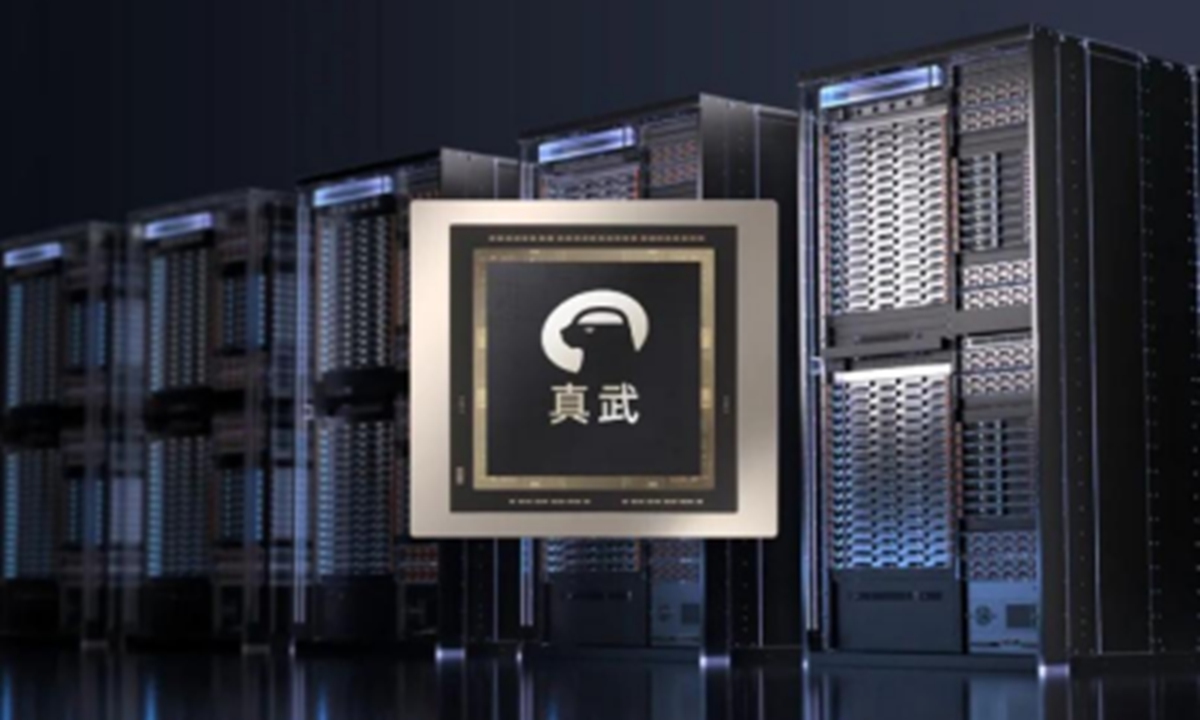
The instance is designed to handle inference for mixture-of-experts models with up to 10 trillion parameters, the company said in a statement sent to the Global Times on Wednesday.
This marks the first supernode-form computing architecture in China to successfully run large language models exceeding 2 trillion parameters, according to the company.
Industry expert Tian Feng told the Global Times that the commercial rollout of supernode infrastructure could significantly reduce training cycles, lower costs, and speed up iteration for AI developers requiring massive computational resources.
The company said the new instance has already been used to power commercial services for large language models such as KimiK3 and Qwen3.8Max.
The Lingjun Zhenwu M890 supernode instance supports FP8/FP4 low-precision computing. Through the ICNSwitch 1.0 chip, its scale-up interconnect scale has been expanded from 16 cards to 64 cards, with inter-card interconnect bandwidth boosted to 800 GB/s. Enterprises can provision 64-card, high-speed-interconnect computing units through the cloud without building their own data centers, according to the company.
In training scenarios such as autonomous driving and embodied intelligence, the instance delivers three times the training performance compared with the previous-generation Zhenwu 810E, the company said.
Ulanqab, where the supernode instance debuted, is one of Alibaba Cloud's five super data centers. The facility sources approximately 90 percent of its electricity from green energy, providing a low-carbon operating environment for high-density computing power.
Leveraging its climate, energy and network advantages, Ulanqab has transformed from "China's potato hometown" into the "token factory" - a term increasingly used in the AI industry to describe infrastructure dedicated to producing the digital building blocks generated by large language models.
By the end of 2025, the city had attracted 84 data center projects, including 81 intelligent computing centers, with total investment exceeding 500 billion yuan ($74.1 billion) and operational computing power reaching approximately 172,000 petaflops, ranking it firmly in the nation's top tier, according to domestic media reports.
On August 6, China's largest AI computing industrial park was completed and put into operation in Ulanqab. The project highlights a broader race in China to build massive AI data centers capable of supporting the next generation of AI models while addressing soaring electricity demand, according to Chinese experts.
In recent years, Inner Mongolia has been rapidly positioning itself as a global-scale AI computing center cluster. Major technology companies, including Huawei, Tencent, ByteDance and Alibaba; telecom operators China Mobile, China Telecom and China Unicom; as well as cyberspace infrastructure service provider VNET, have established computing facilities in the region.
As the AI industry gradually transitions from the training era to the inference era and large model parameters continue to expand, supernodes have become a central battleground for AI infrastructure.
Chinese vendors are accelerating deployments in this space. Huawei has commercially deployed more than 750 sets of its Ascend 384 supernodes across industries including internet, telecom operators, finance, education, healthcare, transportation and manufacturing. It is also the only domestic supernode to have trained state-of-the-art (SOTA) models.
Baidu AI Cloud has also launched its Tianchi 256-card supernode based on Kunlun chips, with support for major models including Wenxin, DeepSeek, GLM, and MiniMax.
Meanwhile, supercomputer manufacturer Sugon has unveiled China's first fully domestic 100,000-card AI supercluster Sugon 8000 (Dengfeng), integrating supercomputing and AI computing on a unified architecture. It has now been connected to the national supercomputing internet to provide computing services to government, research, and enterprise clients nationwide.
Tian, former dean of SenseTime's Intelligence Industry Research Institute, told the Global Times that the flurry of domestic supernode launches reflects a broader inflection point as China's AI sector pivots from training capacity toward efficient, large-scale inference.
The expert further said that the commercial viability of these systems - evidenced by Huawei's extensive deployed base, Baidu's rapid model adaptation and Sugon's integration into the national computing network - suggests domestic vendors are moving beyond proof-of-concept to genuine production-grade infrastructure, a prerequisite for sustaining the next wave of trillion-parameter model proliferation, Tian noted.
The move also underscores China's push for self-reliance in AI infrastructure as US chip export restrictions continue to tighten, Tian said, noting that, in the supernode domain, Chinese companies are shifting from imported graphics processing units toward homegrown interconnect chips and domestic compute clusters, a transition that could reshape value allocation across the AI industry chain.
。 (ECNS)-- In the mountains of southwest China's Guizhou Province, industries once unlikely to be associated with a remote inland region are finding their way into global markets. In Jiangkou County, Tongren, stands what local authorities describe as the world's largest single-site matcha refining facility. Fully automated production lines process the finely ground green tea for consumers at home and abroad. According to local figures, one in every five cups of matcha consumed worldwide is produced in Tongren. The city's matcha products are exported to more than 50 countries and regions, with the industry generating an output value of 750 million yuan ($105 million). For Mauro, a young visitor from Brazil, the industry raised a broader question: how can globally competitive production create opportunities for rural communities? Tongren's matcha industry works with 73 upstream partner companies and around 13,300 hectares of tea plantations. Financial and technical support for growers, alongside links between market demand and production, helps connect local farmers with a wider supply chain. Matcha is not the only Guizhou product reaching international markets. In Jinping County, Qiandongnan Miao and Dong Autonomous Prefecture, local industry figures suggest that one in every 10 shuttlecocks in circulation worldwide is made there. Production is supported by a supply chain extending from goose farming and feather sorting to intelligent manufacturing. "I hadn't realised that some of the key materials used in these vehicles come from Guizhou," said Thai visitor Nim Jiratchaya, whose family owns a Chinese electric vehicle. Guizhou developed an advanced functional materials industry serving sectors including electric vehicles and renewable energy. Digitalization is also changing traditional manufacturing. Guizhou Tyre's intelligent plant was the first in China's tyre industry to join the World Economic Forum's Global Lighthouse Network, which recognizes factories deploying advanced technologies at scale. The facility also uses photovoltaic power, purchased renewable electricity, and waste-heat recovery to reduce emissions. Infrastructure played another role in connecting the mountainous province with wider markets. Nearly half of the world's 100 highest bridges are located in Guizhou, helping overcome terrain that has long complicated transport and economic connectivity. For the visiting Gen Z group, the journey offered a view of China beyond its major cities and coastal manufacturing centres. Tea, badminton equipment, advanced materials, and tyres illustrate how specialised manufacturing, infrastructure investment, and local resources are connecting communities in China's mountainous southwest with national and global markets.

 。
。
二 |
Current article:http://3qw1.cibianpangjujiusu.cyou/list_ab3f/m74a.html
Published on:13:08:45
- 本文标签:
- 无心法师